
Fancy, Marine and Film Faced: Choosing a Decorative Route
Three surface routes cover most decorated panel work: a decorative veneer face, a construction film, or a moisture-first sheet with ordinary faces. The film faced range alone publishes five face films, six thicknesses from 9 to 24 mm and four core options — poplar, eucalyptus, combi and birch. Everything quoted here is taken from the manufacturer's own pages, read 29 Sept 2026.

Key takeaways
- Film faced surfaces come in five films: Dynea dark brown, black, brown, anti-slip and plastic.
- Four cores are offered — poplar, eucalyptus, combi and birch — and the core decides weight and screw holding.
- Grades are one-time hot press, two-time hot press and finger-joint, the last published at 8, 10, 12, 15 and 18 mm.
- An anti-slip face is specified for workshops where vehicles move across the panels, not for appearance.
Three routes, three different priorities
Decoration on a wood panel is a surface decision, and the surface decides how the panel will be used. Fancy plywood leads with appearance: a decorative face veneer in a range of grains and colours, chosen for what a client sees. Marine plywood leads with durability and water resistance, offered in several sheet options, where the face is secondary to what the panel does after it gets wet. Film faced plywood leads with performance under abrasion, moisture and chemicals, which is why it is the usual choice for concrete formwork. All three sit inside one broad grouping that importers file under Commercial Plywood, which is exactly why the route has to be named before two prices are compared.
Naming the priority first saves a round of quotations. A decorative route can tolerate a surface that marks; a film route can tolerate a colour that nobody photographs. Buyers who ask for both at once usually end up comparing a decorative sheet against an industrial one on price per square metre, which is the least informative comparison available in this trade.
Film faced surfaces and what each one is for
The film faced range offers five faces: black film, brown film, plastic film, anti-slip film and the Dynea dark brown film, over three published sheet sizes — 1220 × 2440 mm, 900 × 2100 mm, 1250 × 2500 mm — plus custom sizes on request, in thicknesses running 9 mm, 12 mm, 15 mm, 18 mm, 21 mm and 24 mm, with a ±0.5 mm tolerance. The descriptions on the page explain the practical differences: black film gives high contrast and an even surface with resistance to water, chemicals and wear, while brown film balances durability with cost and is aimed at construction use.
Two films are specified by job rather than by look. Anti-slip film is described for workshop floors and walkways where vehicles move across the surface, and plastic film covers cases where a non-standard face is wanted. Reading a film list this way — surface, then use — turns a decorative question into a site question, which is usually where the answer actually lives.
Fancy and marine: appearance against exposure
Fancy plywood is the family where veneer quality carries the price. Grain run, colour consistency across a batch and freedom from pin knots are what a client notices, and none of those appear on a thickness datasheet. The mitigation is procedural rather than technical: approve a sample from the batch that will ship, and hold a labelled panel from it for comparison against later deliveries.
Marine plywood takes the opposite approach. Its specification is written around durability and water resistance, with several marine sheet options listed, so the questions to raise are about glue system and edge protection rather than face grade. A marine sheet usually fails at an unsealed edge before it fails in the middle, which makes edge treatment a buying decision rather than a finishing detail.
Core build-ups and how they change the panel
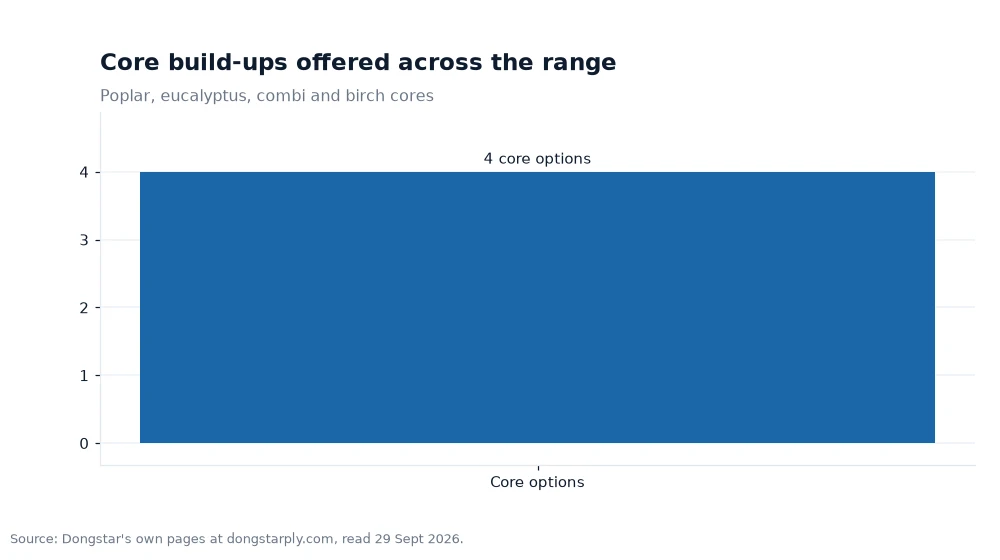
Four cores are listed across the range, and the choice changes weight, machining behaviour and screw holding more than the surface does. Poplar is light, straight-grained, stable and easy to machine, and is described as a good fit for interior work such as cabinets plus furniture. Eucalyptus adds strength, durability and moisture resistance as standard with good load-bearing behaviour. Combi and birch complete the list, and their fit depends on the load and the finish the panel has to carry.
Core species also decide how a panel behaves when it is cut and left in humidity. A light poplar core makes a panel easier to handle but offers less resistance to point loads, while a heavier core holds fixings better and weighs more to install. For a fit-out that is one of the few genuine trade-offs in the specification, and it is decided by how the panel will be fixed rather than by price.
Grading, glue and edge protection
The grade list names finger-joint construction alongside one-time and two-time hot press builds. Finger-joint cores are assembled from shorter lengths of timber joined end to end and are published separately at 8, 10, 12, 15 and 18 mm. The page describes finger-joint construction as suited to work needing structural integrity, including construction, flooring and furniture, because the jointed core resists warping and cracking differently from a continuous veneer core.
Glue and edge treatment finish the specification. WBP melamine is listed as water-resistant and weather-resistant for outdoor, marine, formwork and flooring work, and WBP phenolic adds heat and chemical resistance for indoor and outdoor use under load. Waterproof edge sealing is offered separately, and it is usually the smallest line item in a quotation: sealing protects the edges that get knocked during stripping and handling, which is where most premature panel failures begin.
| Route | What the page states | Where it belongs |
|---|---|---|
| Film faced — films | Dynea dark brown, black, brown, anti-slip and plastic film | Formwork, floors, workshop walkways |
| Film faced — sizes and thickness | 1220 × 2440 mm, 900 × 2100 mm, 1250 × 2500 mm; 9, 12, 15, 18, 21, 24 mm; ±0.5 mm | Specification written against a cutting plan |
| Film faced — cores | Poplar, eucalyptus, combi, birch | Chosen for weight, screw holding and humidity behaviour |
| Decorative route | Fancy plywood: decorative face veneer, many grains and colours | Visible interiors where grain and colour lead |
| Moisture route | Marine plywood: water resistance and durability lead the specification; several sheet options | Wet zones, boat interiors and outdoor joinery |
| Edge treatment | Waterproof edge sealing available | Anywhere panels are handled or stripped repeatedly |
Worked example: reading the option matrix before quoting
The chart on this page records four core options. Pair each core with the six published thicknesses on the film faced range — 24 mm at the top from a ramp that starts at as standard 9 mm, with 12, 15, 18 and 21 mm between — and the quotable combinations reach 4 × 6 = 24 (example arithmetic). Add the five face films and the matrix becomes 4 × 6 × 5 = 120 combinations (example). A buyer who has not stated the job is inviting thirty of those to be priced instead of the two that matter.
Order size follows from the format chosen. Run 800 sheets in the 1250 × 2500 mm size and the area is 800 × (1.25 m × 2.5 m) = 800 × 3.125 = 2,500 m² (example). The same 800 sheets in the 900 × 2100 mm size give 800 × 1.89 = 1,512 m² (example), because that sheet measures 0.9 m × 2.1 m = 1.89 m². A job needing 3,000 m² would take roughly 3,000 ÷ 1.89 = 1,588 sheets in the smaller format, against 3,000 ÷ 3.125 = 960 sheets in the larger one (example arithmetic) — a difference that shows up in pallets, handling and site storage long before it shows up in price.
Frequently asked questions
Which film colours are listed on the film faced range?
Five faces are listed: anti-slip film, plastic film, black film, brown film and Dynea dark brown film. The page notes that black film gives high contrast and an even surface, brown film balances durability with cost for construction work, and anti-slip film is used where vehicles move across the surface.
What do the four core options change?
Poplar is light, straight-grained, stable and easy to machine, and is described for interior work such as cabinets and furniture. Eucalyptus adds strength, durability, moisture resistance and load-bearing capacity. Combi and birch are the remaining options, and their behaviour should be confirmed against the specification sheet for the order.
Which grades exist on the film faced line?
Three builds are published: finger-joint construction, one-time hot press and two-time hot press. Finger-joint cores are listed at 8, 10, 12, 15 and 18 mm and are described for work that needs structural integrity, such as construction, flooring and furniture.
Settling the decorative route
After the surface decision, the remaining questions are about the core and the exposure. The birch plywood page covers a dense, stable option with published thicknesses of 12, 18 and 24 mm, and the particle board range covers the opposite end of the budget, where the panel is stable and easy to machine but never meant to be seen. Choosing between them is quicker once the surface route is fixed.
Surface options, thicknesses, core types and grade descriptions quoted in this article are published on the manufacturer's own pages, checked on 29 Sept 2026, and carried into this comparison[1].