
The recent strategic pivot by Chinese firms like AGIBOT toward embodied AI represents a fundamental shift from digital simulation to high-performance physical automation. From a reader's perspective, the 2026 Government Work Report’s emphasis on the "AI+" initiative serves as a structural catalyst for a sector that is no longer satisfied with "flashy demos." When a company like AGIBOT reports a revenue of 1.05 billion yuan ($154 million) for 2025 and sets a 2027 target of 10 billion yuan ($1.47 billion), we are looking at an aggressive 852% growth trajectory. This level of scaling is only possible because China already controls 90% of global robotics exports, leveraging an ecosystem of over 100 enterprises—double the density of North America.
Technically, the "inflection point" discussed by AGIBOT executives is a matter of quantifying intelligence through token consumption. In the digital era, tokens represent text or pixels; in embodied AI, tokens are the "base currency" for real-time perception, reasoning, and actuator control. For a humanoid robot to operate safely in a factory, it must process these multi-modal tokens with a target latency of under 10 to 20 milliseconds. As reported by the People's Daily, the convergence of large-model reasoning and high-performance computing infrastructure is what allows these agents to move from the lab to the assembly line. By supporting this push with 20 billion yuan ($2.9 billion) in fresh capital during Q1 2026 alone—a 60% year-on-year increase—investors are betting that the "commercial loop" can finally be closed.
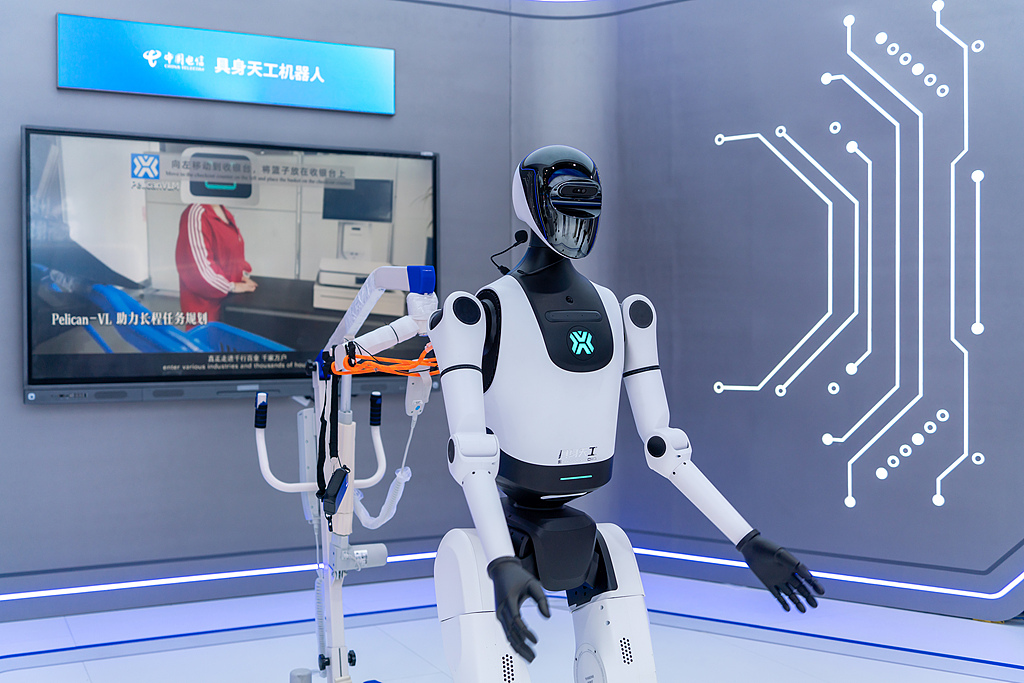
The economics of this transition are driven by a ruthless focus on cost efficiency and supply chain integration. In a typical industrial deployment, a humanoid robot with a 98% operational reliability rate and an 8-to-10-year lifespan can significantly lower long-term OPEX. If the manufacturing clusters can drive down the cost of specialized components like tactile sensors and joint modules by 30% through volume production, the payback period for these units could drop to under 18 months. This is particularly vital for sectors facing labor productivity plateaus, where a 15% increase in efficiency can result in millions of dollars in added margin.
Looking toward 2027, the success of embodied AI will depend on the density of real-world deployment data. To achieve measurable productivity, these robots must endure thousands of hours of training in service environments, reducing the error rate in complex tasks to less than 0.5%. By treating robots as "core gateways" that connect AI models to the physical world, Chinese firms are essentially building a new industrial standard. With high-performance chips enabling robots to sense and act with higher precision, the "AI economy" is no longer a digital abstraction—it is a physical reality measured in billions of yuan, thousands of tokens, and a structural advantage that is becoming increasingly difficult for global competitors to ignore.
News source:https://peoplesdaily.pdnews.cn/tech/er/30051957138