
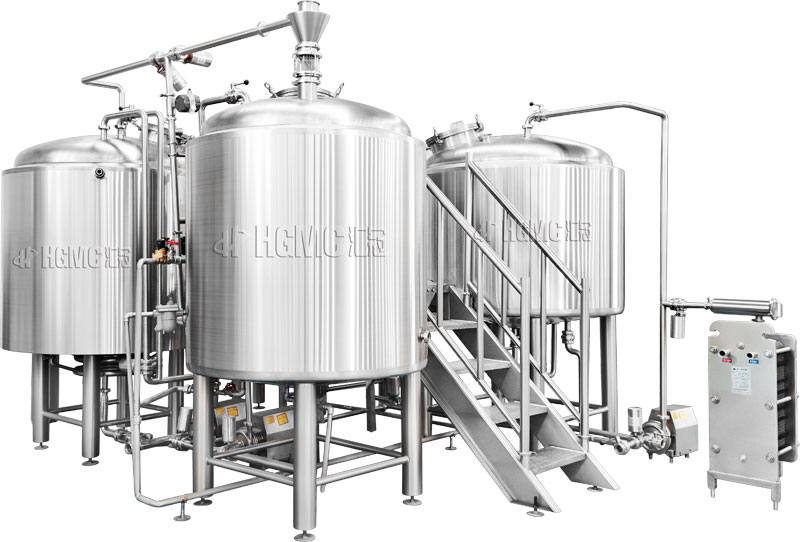
 When the production scale moves towards an annual output of 10,000 barrels or more, highly automated micro brewery equipment becomes the key to maintaining a competitive barrier. The integrated automation control system can reduce labor costs by 40% and increase the capacity utilization rate from 75% to over 90%. For instance, an array of fermentation tanks equipped with an automatic cleaning (CIP) system has a cleaning efficiency three times that of manual operation and a water-saving rate of 50%. Although the price of a single set may be as high as 800,000 yuan, the investment can be recovered within 18 months through the saved operation and maintenance costs. Referring to the expansion strategy of Boston Beer Company, it has reduced the filling loss rate from 3% to 0.5% by introducing an automatic filling line with a flow accuracy of ±0.5%, saving over one million yuan annually.
In today's diversified craft beer market, flexibility has become the core indicator for equipment selection. A set of micro brewery equipment with modular design enables the brewery to achieve a rapid transition from brewing pale ale to cask stout at an additional cost of 10%. For instance, by adding a whirlpool tank with a capacity of 200 liters, the efficiency of dry hop feeding can be increased by 20%. Adding a small plate heat exchanger can increase the cooling rate of wort to 30°C per minute, greatly reducing the risk of oxidation. Data shows that wineries adopting this flexible production solution launch an average of 6 to 8 new products each year, which is twice the number of wineries without this capability. This can effectively respond to the market trend where consumers' tastes change every 12 to 18 months.
Therefore, the best equipment strategy is not to pursue peak production capacity, but to find the optimal solution in the triangular balance of calculating the return on investment, evaluating the accuracy of flavor control and measuring production flexibility. Whether it is a new player with a budget of 2 million yuan or a mature brand planning to expand to 50 million yuan, only by deeply analyzing its annual production growth curve (such as an annual growth rate of 15%) and product style matrix can every equipment investment be transformed into a unique flavor in the cup and sustainable profit growth. Truly realize the brewing revolution from "manufacturing" to "creation".
When the production scale moves towards an annual output of 10,000 barrels or more, highly automated micro brewery equipment becomes the key to maintaining a competitive barrier. The integrated automation control system can reduce labor costs by 40% and increase the capacity utilization rate from 75% to over 90%. For instance, an array of fermentation tanks equipped with an automatic cleaning (CIP) system has a cleaning efficiency three times that of manual operation and a water-saving rate of 50%. Although the price of a single set may be as high as 800,000 yuan, the investment can be recovered within 18 months through the saved operation and maintenance costs. Referring to the expansion strategy of Boston Beer Company, it has reduced the filling loss rate from 3% to 0.5% by introducing an automatic filling line with a flow accuracy of ±0.5%, saving over one million yuan annually.
In today's diversified craft beer market, flexibility has become the core indicator for equipment selection. A set of micro brewery equipment with modular design enables the brewery to achieve a rapid transition from brewing pale ale to cask stout at an additional cost of 10%. For instance, by adding a whirlpool tank with a capacity of 200 liters, the efficiency of dry hop feeding can be increased by 20%. Adding a small plate heat exchanger can increase the cooling rate of wort to 30°C per minute, greatly reducing the risk of oxidation. Data shows that wineries adopting this flexible production solution launch an average of 6 to 8 new products each year, which is twice the number of wineries without this capability. This can effectively respond to the market trend where consumers' tastes change every 12 to 18 months.
Therefore, the best equipment strategy is not to pursue peak production capacity, but to find the optimal solution in the triangular balance of calculating the return on investment, evaluating the accuracy of flavor control and measuring production flexibility. Whether it is a new player with a budget of 2 million yuan or a mature brand planning to expand to 50 million yuan, only by deeply analyzing its annual production growth curve (such as an annual growth rate of 15%) and product style matrix can every equipment investment be transformed into a unique flavor in the cup and sustainable profit growth. Truly realize the brewing revolution from "manufacturing" to "creation".
Default
Which Micro Brewery Equipment Best Fits Different Production Scales and Brewing Styles?
- Published
- Author
- huanggs
- Category
- Default
Choosing the right micro brewery equipment is like finding the exclusive conductor for each brewing symphony. It directly determines the 40% difference in efficiency and flavor between a small workshop with an annual output of 1,000 barrels and a medium-sized brewery with an annual output of 5,000 barrels. According to the 2023 industry analysis by the American Brewers Association, approximately 65% of the initial investment budget is allocated to production equipment. Matching the scale of configuration can increase energy efficiency by 30% and shorten the average brewing cycle per batch from 4 weeks to 3 weeks. For instance, a nano distillery that focuses on American IPA and has an annual output of 300 barrels usually only needs a mashing system capacity of 500 liters, and the total investment in equipment can be controlled within 500,000 yuan. A distillery that plans to produce multiple styles and an annual output of 2,000 barrels requires an integrated system of over 1,500 liters, with an investment budget often exceeding 2 million yuan. However, the production cost per unit of liquor can be reduced by 25%.
For wineries that focus on specific brewing styles, equipment parameters must precisely correspond to the process requirements. Brewing German Lager requires the fermentation tank to maintain a temperature fluctuation of ±0.2°C within the low-temperature range of -1°C to 4° C. This demands dedicated fermentation equipment with additional cooling power, increasing the initial investment by approximately 15%, but it can ensure the precise flavor of yeast metabolites such as diacetyl concentration below 0.1 mg/L. Conversely, breweries that produce Belgian ales or sour beers shift their investment focus to temperature-controlled oak barrels or open fermentation tanks. The fermentation temperature range can be expanded to 18°C-25°C, and over 200 flavor compounds are generated through complex microbial communities. Industry leaders such as the Duvet Distillery in Belgium, with their customized temperature-controlled fermentation systems, achieve a flavor consistency of 98% for their products. This is a perfect example of equipment precisely matching the brewing philosophy.
When the production scale moves towards an annual output of 10,000 barrels or more, highly automated micro brewery equipment becomes the key to maintaining a competitive barrier. The integrated automation control system can reduce labor costs by 40% and increase the capacity utilization rate from 75% to over 90%. For instance, an array of fermentation tanks equipped with an automatic cleaning (CIP) system has a cleaning efficiency three times that of manual operation and a water-saving rate of 50%. Although the price of a single set may be as high as 800,000 yuan, the investment can be recovered within 18 months through the saved operation and maintenance costs. Referring to the expansion strategy of Boston Beer Company, it has reduced the filling loss rate from 3% to 0.5% by introducing an automatic filling line with a flow accuracy of ±0.5%, saving over one million yuan annually.
In today's diversified craft beer market, flexibility has become the core indicator for equipment selection. A set of micro brewery equipment with modular design enables the brewery to achieve a rapid transition from brewing pale ale to cask stout at an additional cost of 10%. For instance, by adding a whirlpool tank with a capacity of 200 liters, the efficiency of dry hop feeding can be increased by 20%. Adding a small plate heat exchanger can increase the cooling rate of wort to 30°C per minute, greatly reducing the risk of oxidation. Data shows that wineries adopting this flexible production solution launch an average of 6 to 8 new products each year, which is twice the number of wineries without this capability. This can effectively respond to the market trend where consumers' tastes change every 12 to 18 months.
Therefore, the best equipment strategy is not to pursue peak production capacity, but to find the optimal solution in the triangular balance of calculating the return on investment, evaluating the accuracy of flavor control and measuring production flexibility. Whether it is a new player with a budget of 2 million yuan or a mature brand planning to expand to 50 million yuan, only by deeply analyzing its annual production growth curve (such as an annual growth rate of 15%) and product style matrix can every equipment investment be transformed into a unique flavor in the cup and sustainable profit growth. Truly realize the brewing revolution from "manufacturing" to "creation".
When the production scale moves towards an annual output of 10,000 barrels or more, highly automated micro brewery equipment becomes the key to maintaining a competitive barrier. The integrated automation control system can reduce labor costs by 40% and increase the capacity utilization rate from 75% to over 90%. For instance, an array of fermentation tanks equipped with an automatic cleaning (CIP) system has a cleaning efficiency three times that of manual operation and a water-saving rate of 50%. Although the price of a single set may be as high as 800,000 yuan, the investment can be recovered within 18 months through the saved operation and maintenance costs. Referring to the expansion strategy of Boston Beer Company, it has reduced the filling loss rate from 3% to 0.5% by introducing an automatic filling line with a flow accuracy of ±0.5%, saving over one million yuan annually.
In today's diversified craft beer market, flexibility has become the core indicator for equipment selection. A set of micro brewery equipment with modular design enables the brewery to achieve a rapid transition from brewing pale ale to cask stout at an additional cost of 10%. For instance, by adding a whirlpool tank with a capacity of 200 liters, the efficiency of dry hop feeding can be increased by 20%. Adding a small plate heat exchanger can increase the cooling rate of wort to 30°C per minute, greatly reducing the risk of oxidation. Data shows that wineries adopting this flexible production solution launch an average of 6 to 8 new products each year, which is twice the number of wineries without this capability. This can effectively respond to the market trend where consumers' tastes change every 12 to 18 months.
Therefore, the best equipment strategy is not to pursue peak production capacity, but to find the optimal solution in the triangular balance of calculating the return on investment, evaluating the accuracy of flavor control and measuring production flexibility. Whether it is a new player with a budget of 2 million yuan or a mature brand planning to expand to 50 million yuan, only by deeply analyzing its annual production growth curve (such as an annual growth rate of 15%) and product style matrix can every equipment investment be transformed into a unique flavor in the cup and sustainable profit growth. Truly realize the brewing revolution from "manufacturing" to "creation".
Ship a press kit sponsors actually open.
Turn scattered links, screenshots, and audience stats into one polished page in under four minutes.